
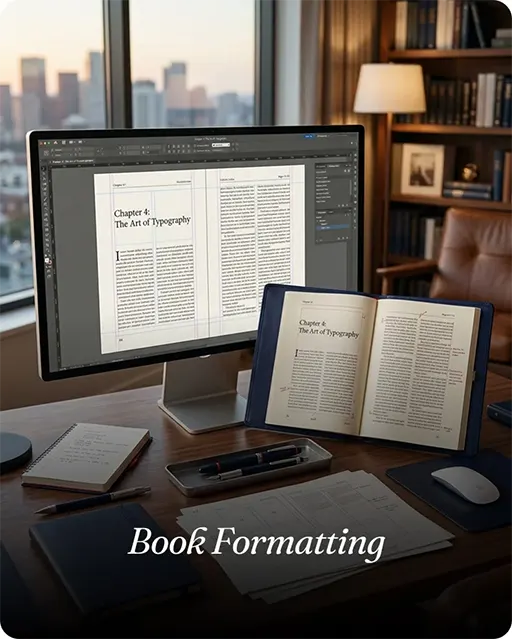
Formatting and typesetting
The pages readers never notice
Good typesetting is invisible: nobody finishes a book admiring the margins. Bad typesetting is the thing that makes a reader put a book down without knowing why.
Print and ebook
These are two different objects
A printed page is fixed. Its dimensions never change, so every decision can be made precisely. An ebook page does not exist: text reflows to whatever screen, font and size the reader has chosen.
Designing for one and exporting to the other is the most common formatting mistake in independent publishing. A print PDF loaded as an ebook forces readers to pinch and drag. An ebook file sent to a printer produces inconsistent spacing and chapter openings landing wherever they happen to fall.
We build them separately from the same edited manuscript, so each is right for its own medium.

Print interior
What goes into setting a page
Each of these is a decision, and each one is wrong in most unformatted manuscripts.
Typeface and size
A text face chosen for sustained reading at the size it will actually be printed, not the size it looks good on a monitor. Licensed for embedding in a commercial print file.
Margins and gutter
Inner margins are wider than outer ones, because the binding swallows part of the page. The wider the book, the more it swallows. This is the single most common fault in self-formatted books.
Leading and measure
Line spacing and line length set so the eye can find the start of the next line without effort. Lines that are too long are genuinely tiring to read.
Chapter openings
Consistent drop, consistent style, and always starting on the correct page (recto or verso) according to the convention you have chosen.
Running heads and folios
Author name and title, or title and chapter, placed consistently and suppressed on chapter openings and blank pages where convention requires.
Front and back matter
Half title, title page, copyright page, dedication, contents, and whatever the back needs: acknowledgements, author biography, other titles. Ordered as readers expect.
Images and tables
Placed near their reference, sized for the text block, captioned consistently, and supplied at print resolution rather than dragged in from a web page.
Widow and orphan control
No single line stranded at the top or bottom of a page. Fixed by adjusting the pages around it, which is manual work and why typesetting takes time.
Ebook build
Files that behave on every device
An ebook is a small website in a wrapper. Built properly it adapts to any screen, any font size and any reading preference. Built badly it carries hard-coded fonts, fixed indents and page breaks in the wrong places.
- Reflowable text that respects the reader's chosen font and size
- A working navigable table of contents
- Semantic heading structure, which is what screen readers rely on
- Chapter breaks that land correctly regardless of device
- Images with alt text and sensible file sizes
- Validated EPUB, plus Kindle compatibility checked
We test on multiple devices and screen sizes before delivery, because emulators are not the same as a real phone at midnight with the brightness down.
Trim sizes
Choosing the shape of the book
Trim size affects page count, printing cost, retail price and whether your book looks like others in its category. It is worth choosing deliberately.
| Trim size | Commonly used for | Notes |
|---|---|---|
| 198 × 129 mm (B format) | Literary and general fiction | Familiar Australian paperback proportion |
| 203 × 133 mm (5.25 × 8") | Fiction, memoir | Widely supported by print-on-demand |
| 229 × 152 mm (6 × 9") | Non-fiction, business, textbooks | Fewer pages for the same word count |
| 234 × 156 mm | Academic and reference | Room for wide tables and figures |
| Square and landscape | Children's picture books, photography | Check availability with your printer first |
Available trim sizes differ between printers and between print-on-demand services. We confirm what your chosen supplier actually offers before typesetting begins, because changing trim size afterwards means resetting the entire interior.
How it works
From edited file to finished files
Specification
Trim size, printer, paper stock and format list confirmed, along with your editorial style sheet.
Design sample
A short sample (chapter opening, body pages, front matter) for you to approve before the full book is set.
Full typeset
The complete interior set, with manual attention to page breaks, widows and image placement.
Delivery
Print-ready PDF, validated EPUB, and a page count you can hand to your cover designer.
Questions
Formatting questions, answered
You can, and for a simple text-only book with careful setup it can be adequate. Where it falls down is the detail: gutter margins, widow control, consistent chapter drops and correctly suppressed running heads. Those are the things that make a book look professionally produced, and Word does not handle them well without a great deal of manual work.
Only if you are releasing both editions, but most independent authors do because the ebook carries the higher royalty rate and the paperback carries the credibility. They are quoted separately so you can take one or both.
The final edited manuscript in Word or a similar format, your editorial style sheet, any images at full resolution, and your chosen trim size and printer. Formatting should happen after editing is complete: reformatting because a chapter changed is avoidable expense.
Yes. Illustrated books, cookbooks, photography titles and children's books all need image-led layout, which is more involved than straight text and quoted accordingly. Colour printing also changes the economics, so it is worth discussing early.
Yes. We deliver a validated EPUB and check Kindle compatibility, since Amazon converts EPUB on upload. We test across multiple devices and screen sizes before handing over.
Small corrections are straightforward and usually covered by the initial quote. Substantial rewrites mean resetting affected sections, and if the page count shifts, the cover spine has to be rebuilt too. It is much cheaper to finish editing first.
Continue
Stages around formatting
Most authors combine two or three services. Tell us where your manuscript is and we will recommend only what it needs.
Get a quote
Send the word count and we will quote the interior
Tell us your manuscript length, intended trim size, whether you need print, ebook or both, and how many images are involved.
- Design sample approved before the full set
- Print PDF built to your printer's specification
- Validated, accessible EPUB
- Final page count supplied for your cover
Prefer to talk it through? +61 2 8531 1369 · info@harbourbridgepress.com