

Ghostwriting
You have the story. We have the hours
Memoir, business and non-fiction books written with you and published under your name. You supply the material, the experience and the judgement; a professional writer does the drafting.
How ghostwriting works
It is your book. Someone else types it
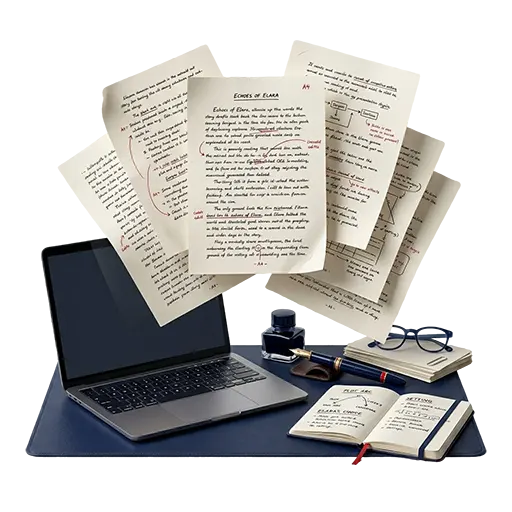
A ghostwriter is not a co-author and not a consultant. They are a professional writer who learns your material and your voice thoroughly enough to write as you, then disappears from the finished book entirely.
Most people who commission a ghostwriter are not short of a book. They are short of eight hundred hours. They have run the business, lived the life, or built the expertise, and they have discovered that having something to say and being able to sustain ninety thousand words of prose are unrelated skills.
The work is collaborative and demanding on your side too. Expect interviews, follow-up questions, and chapter drafts coming back to you for correction. What you will not do is stare at a blank page.
Who commissions a ghostwriter
Four books we are asked for most often
Memoir
A life, or a defining part of one, shaped into something a stranger will want to read.
Business
The method, the turnaround or the framework, written as a credible book rather than a brochure.
Family history
Records, letters and interviews turned into a narrative the family will actually read.
Expertise
Specialist knowledge translated for readers who do not share your professional background.
The process
How a book gets written this way
Roughly six to twelve months for a full-length book, depending on length, research and how quickly drafts come back.
Concept conversation
What the book is, who it is for, and what it needs to achieve. This is also where we work out whether a book is genuinely the right format: sometimes it is not, and we will say so.
Writer matching
We match you with a writer suited to the subject and the register. You read a sample of their work before committing, and if the fit is wrong we find someone else.
Research and material gathering
Documents, records, correspondence, earlier drafts, notes: anything you already have. For business books this often includes existing talks, articles and internal material.
Interviews
Recorded conversations, usually in blocks of an hour or two. This is where the voice is captured. Most projects run somewhere between ten and thirty hours of interviews in total.
Outline and structure
A chapter-by-chapter plan you approve before any drafting begins. Rearranging an outline takes an afternoon; rearranging a finished manuscript takes months.
Chapter drafting
Chapters are written and sent to you in batches rather than held back to the end, so the voice can be corrected early instead of across the whole book.
Revision
Your notes are worked through, factual corrections applied, and the manuscript brought to a consistent finish across all chapters.
Handover
You receive the completed manuscript with copyright assigned to you, ready for editing, design and publication.
Voice
The part that actually matters
Anyone can assemble your facts into chapters. The difficulty is writing them so that people who know you recognise you on the page, and people who do not know you believe the person behind it.
Voice comes out of the interviews rather than out of a questionnaire. A good ghostwriter is listening for how you build an argument, what you find funny, the things you say often, the words you would never use, and where you become guarded. Those patterns are what get reproduced.
- Recorded interviews rather than written questionnaires
- Early sample chapter specifically to calibrate voice
- Your existing writing and talks used as reference
- Drafts delivered in batches so corrections compound

Confidentiality
The writer's name appears nowhere
Ghostwriting only works if it is genuinely invisible. Confidentiality is written into the engagement rather than offered as a favour.
- The writer is contractually bound to confidentiality
- Copyright in the manuscript is assigned to you
- No credit, byline or acknowledgement unless you want one
- Your project is never used in our marketing without permission
- Interview recordings and notes handled as confidential material
- A mutual non-disclosure agreement available on request
Specific confidentiality terms are set out in your written agreement before any material changes hands.
After the manuscript
A ghostwritten book still needs everything else
Ghostwriting produces a manuscript, not a published book. What follows is the same sequence any other manuscript goes through.
Editing
An independent editor reads the completed manuscript. A ghostwriter is too close to their own draft to edit it, exactly like any other author.
Design
Cover and interior, built for the genre and the intended readership.
Production
Print-ready files and a separate ebook build, plus audio if you want it.
Publication
ISBN, metadata, listings and distribution setup under your name or your imprint.
Questions
Ghostwriting questions, answered honestly
Yes, and it is far more common than most readers realise: a substantial share of business books, celebrity memoirs and political autobiographies are ghostwritten. The material, the experience and the judgement are yours. The drafting is a craft skill you are commissioning, in the same way you would commission a photographer rather than take the cover shot yourself.
More than people expect. Budget for ten to thirty hours of interviews, plus reading time for each batch of chapters. The writer removes the drafting burden, not the thinking. Projects that stall almost always stall because the author could not make time for interviews.
You do. Copyright in the manuscript is assigned to you as part of the engagement, and you publish it under your name. The writer retains nothing and receives no royalty.
That is what the early sample chapter is for: to catch a voice mismatch before eighty thousand words exist. Revision rounds are built into the schedule, and if the fit turns out to be genuinely wrong we would rather change the writer than push on.
Often, yes. Diaries, letters, transcripts, blog posts, recorded talks and abandoned drafts are all usable. It generally reduces interview time, though rarely as much as authors hope, because raw material tends to be uneven in coverage.
No one can promise that, and you should be wary of anyone who does. What we can commit to is a well-written, well-structured manuscript that reads as though you wrote it. Sales depend on the market, the subject and the promotion behind it.
It is the most substantial service we offer, because it represents several months of professional writing time. Cost depends on final word count, research required and interview volume. We quote after the concept conversation, once the scope is genuinely clear.
Continue
Where authors go from here
Most authors combine two or three services. Tell us where your manuscript is and we will recommend only what it needs.
First conversation
Tell us what the book is meant to do
An initial conversation about your material, your readers and the scope of the project. No cost, no obligation, and treated as confidential from the first message.
- Confidential from first contact
- Writer matched to your subject and register
- Sample of the writer's work before you commit
- Copyright assigned to you on completion
Prefer to talk it through? +61 2 8531 1369 · info@harbourbridgepress.com