
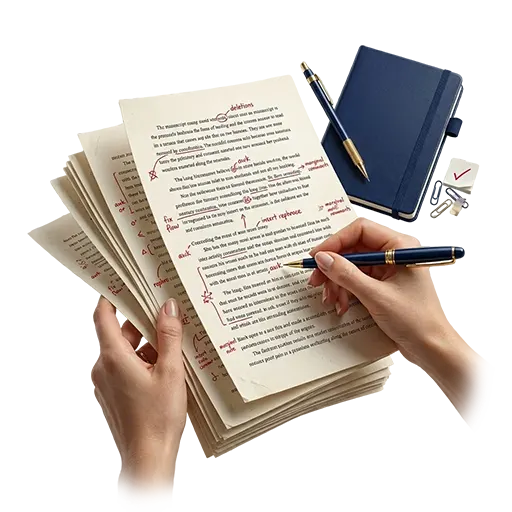
Proofreading
The last read before it is permanent
Once a book is printed, every error in it is printed too. Proofreading is the final controlled check across the typeset pages: the stage that catches what six earlier passes missed.
The final stage
Quality control, not a second edit
Proofreading happens after typesetting, on the pages exactly as a reader will see them. By this point the writing is settled. The proofreader is not there to improve your prose; they are there to make sure nothing embarrassing survives to print.
It is the only stage where someone reads the laid-out book cold, without knowing what it is supposed to say. That is precisely the point. Authors and editors who have read a manuscript twenty times cannot see it any more: the brain supplies what it expects. A fresh reader sees the missing word in the chapter heading.
It is also the last chance to catch problems that only exist once a book is typeset: a widow line, a chapter starting on the wrong page, a running head carrying the previous chapter's title.
The checklist
What a proofreader is hunting for
Two separate passes: one for language, one for layout. Trying to do both at once is how errors get through.
Language pass
- Spelling, including proper nouns and place names
- Punctuation, quotation marks and apostrophes
- Grammar slips introduced during revision
- Doubled or dropped words: the hardest to see
- Australian English consistency against the style sheet
- Numbers, dates, measurements and their formatting
- Character names, terms and capitalisation holding steady
Layout pass
- Running heads and folios correct on every page
- Chapter openings falling where they should
- Widows and orphans at the foot and head of pages
- Bad hyphenation breaks and rivers in justified text
- Contents page matching the actual page numbers
- Front matter, copyright page and back matter complete
- Image placement, captions and figure numbering
Australian English
Consistency matters more than any single rule
Australian English sits between British and American conventions, and drifts if nobody is holding the line. Word processors default to US spelling, imported research carries its own conventions, and a manuscript written over three years will contain all three.
Spelling
-ise over -ize, colour not color, centre not center: applied to every instance, including in dialogue and headings.
Punctuation
Single or double quotation marks chosen once and held; serial comma used or not used consistently; dashes styled the same way throughout.
Local usage
Place names, institutions, currency, dates and measurements checked against Australian convention rather than silently Americanised.
How it works
Four steps, and then you are ready to print
Proofreading works on a fixed file. Any change you make after this stage needs re-checking, because moving one line moves every line after it.
Receive the proof
You send the typeset PDF plus the editorial style sheet, so the proofreader knows which conventions the book has already committed to.
Language pass
A full read for spelling, punctuation, grammar and consistency, marked as PDF comments against the exact page and line.
Layout pass
A second pass looking only at how the pages sit: headers, breaks, spacing, contents accuracy and image placement.
Marked proof returned
You receive an annotated PDF and a summary list of corrections, ready to hand to your typesetter, or to us, if we set the book.
Print proof check
Then check it again on paper
Once corrections are applied, we recommend ordering a physical proof copy before the book goes on sale. Screens are unreliable about things paper makes obvious.
- Cover colour, which almost never matches the screen exactly
- Spine text alignment and whether it sits centred once bound
- Inner margin width: text disappearing into the gutter is common
- Ink density and whether the type is comfortable at actual size
- Trim accuracy against the bleed you supplied
It costs the price of one book and a week of postage, and it is the single most worthwhile check in the whole process.
Questions
Proofreading questions, answered
Yes. Editing and proofreading catch different things at different stages. Corrections made during editing introduce new errors: a sentence gets rewritten and a word is left behind. Typesetting introduces its own problems that did not exist in the manuscript at all. A proofread is the only pass that sees the book as the reader will.
We can, and sometimes it is the right call, for an ebook-only release, for instance, where there are no fixed pages. But you lose the layout pass entirely, and layout errors are roughly half of what a proofread catches on a print title.
A typical 300-page book takes around one to two weeks across both passes. Rushing it defeats the purpose; a proofreader working too quickly is functionally the same as no proofreader.
We will tell you straight away rather than quietly proofreading around them. Occasionally a proof reveals that a chapter needs work that should have happened at the editing stage. It is better to hear that before you print than after.
By default we return a marked-up PDF with a corrections list, which your typesetter applies. If we typeset the book, we apply the corrections ourselves and send you a revised proof to confirm.
Yes, and it is a common request. We check the whole text against Australian conventions and flag anything that has been Americanised or Anglicised in an earlier pass.
Continue
Stages either side of proofreading
Most authors combine two or three services. Tell us where your manuscript is and we will recommend only what it needs.
Before you print
Get a final check while it is still fixable
Send us your typeset pages or your manuscript with the word count, and we will quote for a full proofread with a realistic turnaround.
- Separate language and layout passes
- Checked against your editorial style sheet
- Marked PDF plus a plain corrections list
- Print proof guidance included
Prefer to talk it through? +61 2 8531 1369 · info@harbourbridgepress.com